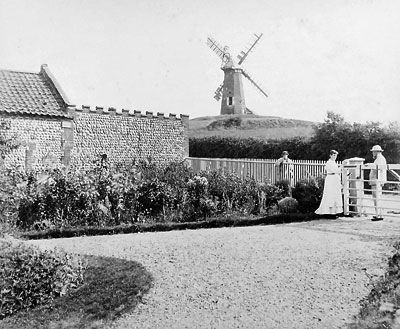
A corn mill in Northrepps, stood on the site earlier occupied by a Northrepps smock mill, that burnt down on 24th November 1836 and that mill was preceded by the even earlier Northrepps postmill.
The mill was actually known as Sidestrand mill due to the access to the mill from the coast road and the Mill House being in Sidestrand. Rates for the mill, were paid to Northrepps Church as it stood within the Northrepps parish boundry.
Description of the mill
The 10 sided four storey wooden mill was set over a single storey brick base.
The mill tower was tarred and the mill was sometimes known as the Black Mill.
Four double shuttered sails powered 2 pairs of stones.
One pair of sails had 8 bays of 3 shutters and the other pair had 6 bays of 3 shutters and 1 pair of 2 shutters.
The Norfolk boat shaped cap had a gallery and held an 8 bladed fan, each blade was painted red with blue and white bands.
The mill was shown on old historic sea charts as the Black Mill and used as a seamark to those at sea.
History of Northrepps Mill from 1836
October 1837: Newly built mill advertised to be let
White's directory 1845: John Lee, corn miller
White's directory 1854: Henry Lee, corn miller
1857: Henry Lee, miller
July 1857: Mill advertised for sale by auction
1859: Henry Lee, miller
White's directory 1864: Henry Lee, corn miller & farmer
1868: Henry Lee, miller
1871: John Starling, miller & farmer
September 1871: Mill advertised to be let
1872: John Starling, miller & farmer
1875: Alfred Jermy, miller
Kelly's directory 1879: Alfred Jermy, miller
White's directory 1883: Alfred Jermy, corn miller
White's directory 1890: Alfred Jermy, corn miller
Alfred Jermy died October 1916 aged 82 after being married four times.
No known tennent after 1916
6th November 1921 the mill was blown down in a gale.
WHEN CLEMENT SCOTT CAME TO VISIT
Louie Jermy, or "The Maid of the Mill" as she came to be known, was a lifelong resident of Sidestrand, a small English hamlet on the north coast of Norfolk that became a thriving tourist mecca during the mid-1880s. The small, out-of-the-way village was discovered by Clement Scott, theatre critic and travel writer for London's Daily Telegraph, who happened upon it while on assignment in Cromer, a coastal resort on the furthest extension of the Great Eastern Railway line. Searching for a peaceful respite from the holiday beach crowd at Cromer, Scott wandered two miles inland where he discovered first a deserted churchyard and tower, and then a windmill and the red-brick farm cottage leased by Alfred Jermy, a widowed miller, and his charming 19-year-old daughter Louie. Scott was so overcome with the peaceful beauty of the place that he took up residence in the cottage for a few days, enjoying Louie's sumptuous country meals and wandering the hillsides and the deserted beach in solitude. He dubbed the place "Poppyland" because of the profusion of red poppies that blanketed its hillsides.
Scott recounted his impressions of Poppy-land in his newspaper column for several weeks, attempting to disguise the identity of the village by calling it "Beckhythe." The idyllic setting, however, soon captured the imagination of London's literary and artistic society, and before long many famous names made their way to the Old Mill House of Scott's description. Among the early visitors to enjoy Louie Jermy's cheerful hospitality were the eminent Victorian poet Algernon Charles Swinburne and his fellow writer Theodore Watts-Dunton. Swinburne composed parts of his poem A Midsummer Holiday while staying at the cottage, and Watts-Dunton paid homage to the place in his novel Aylwin, though he did not refer to it by name. Soon, the area became a fashionable summer destination for London celebrities and the cottage's guests grew to include notables like writer George R. Sims, who made Louie Jermy something of a celebrity by mentioning her in his regular feature "Mustard and Cress," which appeared in the Sunday periodical, The Referee. (At one point, Louie was taken to London by some of the society patrons of the cottage, but she felt out of place in the city and could not wait to get home.) Other guests to the cottage included playwright Robert Rees, publisher Andre Chatto, and actors Henry Irving, Herbert Beerbohm-Tree, and Ellen Terry . As more and more famous names were drawn to the area, other villagers opened their cottages to guests, and many titled people began purchasing land and building grand summer houses. For a while, the place became known as "the village of millionaires."
Poppyland did not attract the general public for some time, mainly because of its obscure location and lack of facilities. Its status as a summer retreat for the rich and famous changed abruptly, however, with a series of events beginning with the publication of Clement Scott's poem "Garden of Sleep," written while standing in the churchyard in 1885 and published in The Theatre, a periodical he edited. (The poem also appeared in Scott's later book Poppyland Papers.) The verse caught the attention of popular songwriter Isidore de Lara, who set it to music and turned it into the popular song "The Hush of the Corn," which captured worldwide attention. Now, everyone clamoured for information about Poppyland. The entrepreneurial railways soon capitalized on public curiosity by advertising Poppyland as a destination of choice. Scott himself continued to visit Poppyland regularly—summer and winter—over the course of 15 years, and later published Blossom Land and Fallen Leaves, an expanded story of Poppyland and the surrounding Norfolk countryside. Other journalists followed suit, and there was a glut of guide books and articles on the place, as well as postcards, souvenirs, and even a Poppyland perfume, supposedly made from the oil of the poppies.
By 1904, the year of Scott's death, Poppy-land had turned into what he termed "Bunga-lowland," attracting not only the bed-and-breakfast set, but day-trippers as well. During World War I, the area was taken over by the army, and the Jermys hosted military brass in the same homely accommodations that had attracted more select visitors. In 1916, as the war raged, a storm blew in and devastated the old church tower, which collapsed down the cliff's edge into the sea along with many old tombstones. After the war, the cottage attracted a younger, less sedate crowd and in 1919, a year after her father's death, Louie was given notice by her landlord to leave the cottage. George Sims, still writing for The Referee, noted her departure in his column: "And now the hospitable reign of the Jermys in Poppyland has come to an end and the Old Mill House will know the joy of Louie's blackberry puddings no more. I stain the paper with a tributary tear."
Rescuing only few treasures from the auction block, Louie Jermy left the pristine cottage of her birth to live out her life in a nearby terrace home. Although she qualified for an old age pension, she refused it because it smacked of charity. For several years, she delighted the locals with poetry readings, wearing the same picture hat framed with poppies that she wore as a girl. When she died in 1934, her coffin was carried by four fishermen from the village and placed in her family plot in the churchyard, the "Garden of Sleep" of Scott's poem.
(Appleyard, Simon. "Poppyland," in This England. Autumn 1987, pp. 10–15.)