
Places in our Parish
Our archive is centred around events and places, take a look below at all the places we have catalogued to date, with more be added all the time.


Farming in Northrepps
Northrepps had up to 11 different farms in the parish including
Steel's Farm ( Now Manor Farm)
Winspurs Farm (At the Airfield)
Church Farm (North of the Church)
Grove Farm (North of New Street)
Grief Farm (Hungry Hill)
Skinner's Farm (Norwich Road A149)
Middle Farm (Crossdale Street)
Laural Farm (Hall Road)
Pit Farm (Demolished when New road junction with A149 was built)
Ling Farm then Grief Farm (Now Shrublands)
Northrepps Estate


Foundry works in Northrepps
The First Foundry at Northrepps
William Hutson, born in 1786 in Bodham established the first foundry in
Northrepps. In 1815 at the age of 29, recently married to Tabitha Latten and
with his first born son William junior, the first of Hutson’s buildings were
erected in the village.
This site is now the adjoining car park of todays pub, the Foundry Arms in Church Street.
There was no pub when Hutson set up his new business, but in due course
one of the local cottages became a ‘beer house’ to accommodate the thirst of
the foundry workers. With the establishment of the early form of public house
became a beneficial relationship as the riders and carriages would use
Hutson’s foundry to have carts repaired and horses re-shod.
The foundry attracted associated trades of the blacksmith, farrier,
wheelwright, cartwright and casting, which enabled the making of ploughs,
drills, pumps and a wide range of farming implements.
Whatever local farmers required Hutson would produce. The most important of these being
the ‘Hutson plough’
By 1859 with the business renamed William Hutson & Sons, Hutson senior
handed over full ownership of the business to his son William junior.
Due to his increasing infirmities and having more interest in ownership of the
foundry and other property that he had acquired over the years. He would
often take his carriage out to the rural countryside and talk to ploughman and
farm workers in the fields.
In 1862 William passed away at the age of 75.
His son William Latten Hutson, aged 50, being the sole owner of the foundry
and smithy was set to run the family business for many years to come,
however, just two years later William junior died suddenly at the age of 52.
With a bleak prospect ahead the foundry was rudderless and local employees
and their families faced an uncertain future. As did local ironmongers
Randell’s in North Walsham, who were threatened with a sudden loss of
supplies for metal items which the Northrepps business had provided.
The Randell family had to react quickly and they arranged to take over the
operation of the extensive iron works at Northrepps and ran the business for
the next five to six years.
Randell’s was founded in the 1820’s by Frank Randell with an ironmongery
shop in North Walsham. Prior to the arrival of the railway, the pig iron and
coke and was brought by wherry to North Walsham and transported by horse
and cart to Northrepps. James Randell then took over control of the business
in North Walsham and Northrepps during this time until his death, when his
widow took over. The Randell family decided to establish their own foundry in North Walsham and by 1867 their new foundry and associated building was opened on the Bacton Road (site of Sainsbury’s supermarket) and was known as the St. Nicolas Works.
Much of the Northrepps equipment was transferred to the new manufacturing unit. Having changed the name form M. Randell & Sons the changed to a limited company F. Randell Ltd and were contracted to
supply various wrought iron park furniture.
Once the North Walsham manufacturing unit became fully operational the Northrepps foundry was
relinquished.
In around 1870 the foundry was bought by Edmund Curties and renamed the Curties and Company. This was financed by funds of the estate of the Golden family, however, due to the premature death of Edmund this brought a halt to the foundry operations alongside the pub. The existing building remained but
only ‘smithy’ work continued for a time.
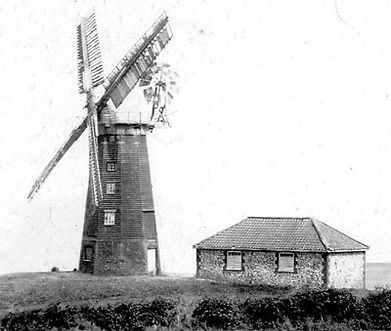
Northrepps Windmill
A corn mill in Northrepps, stood on the site earlier occupied by a Northrepps smock mill, that burnt down on 24th November 1836 and that mill was preceded by the even earlier Northrepps postmill.
The mill was actually known as Sidestrand mill due to the access to the mill from the coast road and the Mill House being in Sidestrand. Rates for the mill, were paid to Northrepps Church as it stood within the Northrepps parish boundry.
Description of the mill
The 10 sided four storey wooden mill was set over a single storey brick base.
The mill tower was tarred and the mill was sometimes known as the Black Mill.
Four double shuttered sails powered 2 pairs of stones.
One pair of sails had 8 bays of 3 shutters and the other pair had 6 bays of 3 shutters and 1 pair of 2 shutters.
The Norfolk boat shaped cap had a gallery and held an 8 bladed fan, each blade was painted red with blue and white bands.
The mill was shown on old historic sea charts as the Black Mill and used as a seamark to those at sea.

Church Farmhouse (Toad House)
Church Farm House, dated 1681 is one of the oldest buildings in Northrepps.
It's first listing we can find is on the 1851 census, being run by James Emery.
For the next 70 plus years the farm was run by the Ling family. Firstly Edward followed by Thomas then Elizabeth and finally Henry.
The Ling family orginated from Campsea Ashe in Suffolk. They were enticed up to Norfolk by the Gurney family, who lived at Hempstead Hall near Holt, they farmed at Hemstead
Edward (one of the sons) with his wife Elizabeth took on the farm and together they had 19 children.
After Edward was gored by a bull and died of his injuries. Thomas took over for a few years befor Elizabeth ran the farm, until well into her 60's.
The Fourteenth child of Edward and Elizabeth, Ralph Ling went into training as a chemist in Yarmouth. Elizabeth paid for Ralphs 3 year apprenticeship .
Ralph became manager of Maws chemist on Church Street Cromer, then opened his own chemist in Cromer.
In 1906 he took ownership of a chemist in North Walsham Market place (Photo below with John Goldens car outside)


Post Office
Northrepps Post Office c 1910 (The Stamp Book)
Kelly’s Directory of Norfolk tells us that the Postmaster in 1900 was Henry Wells. The 1901 Census shows him as Post Office and Grocer. His wife at that time was Rachel Appleton. By the 1911 census Rachel was a widow at Crossdale St, Northrepps. She identifies herself as the Sub Post Mistress G P O. Her son Henry is also listed as the Postman.


Hill House
Sometime between 1553-1606 – Hill House was built
From 1700’s – Owned by the Gurney family, used as accommodation for visitors and Estate workers
1891 Census for Hill House –
Henry Risebrow (43) Head of house - Gardener and domestic servent
Maria Risebrow (40) Wife – Caretaker
William Risebrow (19) Son – Harness Maker
1911 Census for Hill House -
William Walter Burdett (36)
Mary Ann Burdett (35)
Hilda Mary Burdett (13)
William Frank Burdett (10)
Leonard Valentine Burdett (8)
Nellie Rachel Burdett (5)
Walter Burdett (3)
Cora Marguerite Burdett (1)
1926 – Cecil Elizabeth Cambell died at Hill house
1939-45 - Headquarters of the local resistance army during world war two.
1965-66 – Verily Anderson lived in Hill House
1977 – Sir Christopher White lived in Hill House
1978 - 4th January Fire gutted Hill House (Newspaper report)
1984 – Hill House rebuilt

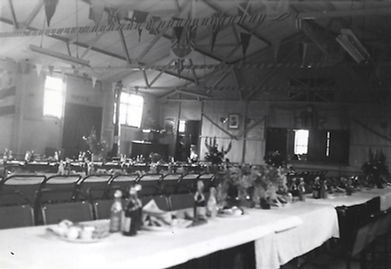

No.26 Hungry Hill
Entry Name: 26, Hungry Hill
Listing Date: 5 April 1989
Grade: II
Source: Historic England
Source ID: 1373498
English Heritage Legacy ID: 224732
Location: Northrepps, North Norfolk, Norfolk, NR27
County: Norfolk
Civil Parish: Northrepps
Traditional County: Norfolk
Lieutenancy Area (Ceremonial County): Norfolk
Church of England Parish: Northrepps St Mary
Church of England Diocese: Norwich


Railways through Northrepps
Two railway lines ran through Northrepps
One being the Norfolk and Suffolk Joint Railway also owned by the Midland and Great Northern and Great Eastern. This line ran from North Walsham Town station to Cromer Beach station and beyond. Opened on 3rd August 1906 and closed on 7th April 1953.
The other being the Great Eastern Railway from Norwich Thorpe station to Cromer High station. Opened 20th October 1872 and extended to Cromer Beach station in 1877.
Cromer High station closed 20th September 1954
Photo shows the signal box at the junction for the line, on the right to Cromer High, going under the bridge at the end of the Avenue in Northrepps and the line to the left going to Roughton Road/Cromer Beach stations and beyond.
On the raised land behind the signal box is where Christopher's Close has been built


Old Manor Farmhouse
First listed 15.02.1988
Grade 2
House now divided in two.
Early C17 with later alterations.
Quaternary flint and chert with brick dressings. Thatched roof. Rectangular in plan, of two builds.
Right hand house of three bays, two storeys of knapped flint. Central C20 single storey brick and flint porch.
To the right of it a five-light painted masonry mullioned and transomed window with smaller two light mullioned window beside stack to ground and first floors, all with rendered reveals.
To left of porch a four-light casement to ground floor; two more C19 casements to first floor. All windows with diamond leaded panes.
Left hand house of three bays two storeys flint with galleting with similar C20 porch; a three light C19 casement to each side. Three cross-casements to first floor.
Crow-stepped gable to shared wall and to gable ends. C17 polygonal clustered shafts to stack at right hand end. Axial and left hand end stacks C19.
Right hand gable wall has diapering; two blocked attic lights with hood moulds. Left hand gable with platband.
Local History
Home to John Golden
Area in front of the house known as Golden Square